
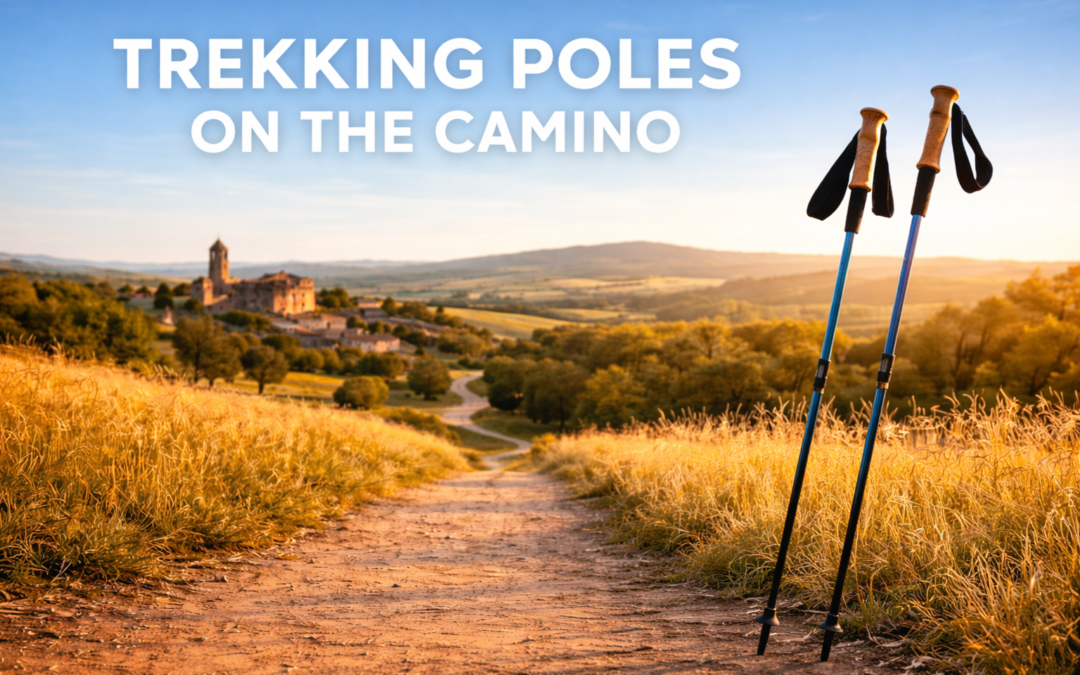
Walking the Camino means long days on mixed terrain: asphalt, gravel tracks, muddy forest paths, steep ascents, and knee-testing descents. Trekking poles are not just for mountain hikers; they are one of the most effective tools for reducing strain and increasing comfort on a multi-day pilgrimage. In this short blog I collected some useful information about trekking poles.
Used correctly, poles help distribute impact across the whole body, taking pressure off knees, ankles, and hips. Studies and long-distance walkers alike report reduced joint pain and fatigue, especially on downhill sections. Poles also improve balance and stability, which is invaluable on rocky paths, slippery descents, or when walking with a full backpack. Many pilgrims find that poles help maintain a steady rhythm, making long distances feel more manageable and less exhausting. Walking with trekking poles, your steps will be longer, and you will walk faster, although the Camino is not a race, so the extra distance is just an additional advantage you will notice. Many pilgrims only realise halfway through their walks how valuable it is to have poles that can disappear when not needed.
Correct use is key. Poorly adjusted poles can cause shoulder or wrist pain rather than prevent it. Tip: Adjust the length correctly. On flat ground, your elbow should form roughly a 90-degree angle when holding the grip with the pole tip on the ground. If your poles are adjustable, you can shorten them slightly for uphill sections and lengthen them for descents. You can also use the wrist straps. Slide your hand up through the strap from below, then grip the handle. This allows your wrist to carry some of the load and prevents gripping too tightly.
It’s not difficult to learn how to use them: just walk naturally. The poles should move in the opposite direction of your legs. Right pole with left foot, left pole with right foot, just like your natural arm swing while walking at a steady pace. Tip: On paved sections, some pilgrims choose to stow poles to reduce vibration, while others prefer rubber tips for comfort and noise reduction.
For the Camino, lightweight, foldable trekking poles are strongly preferable to heavy models. The route includes towns, cafés, buses, albergues, and occasional days when you may want to walk without poles. Carbon or lightweight aluminium poles reduce arm fatigue over long distances, and foldable designs are especially helpful when navigating airports, public transport, or crowded urban sections of the Camino. Tip: Foldable poles can be quickly collapsed and stored in or on your backpack, making them far more practical for pilgrimage-style travel.
Trekking poles are generally considered dangerous items in airline security, as they can be used as striking implements. As a result, most airlines and airport security authorities do NOT allow trekking poles in cabin (carry-on) luggage, even if they are foldable. The rule applies to both metal and carbon poles, regardless of tip covers. However, foldable poles are sometimes allowed at the discretion of security staff, but their decision is unpredictable and should not be relied upon. I have excellent experience with this discretion with my foldable carbon poles (Black Diamond Carbon Z Poles) in Barcelona, Madrid, Santiago, Bilbao, Budapest, Luxembourg, and Bergamo. Tip: Pack trekking poles in checked luggage, ideally well protected. If you are travelling with only a carry-on, you can consider buying poles after arriving in Spain or Portugal, where they are widely available. If you have foldable poles and want to try taking them onboard, fold them and place them inside your bag rather than attaching them to the outside. Airline rules can vary, and airport security have discretion in deciding what they consider a dangerous item, but security screening decisions are ultimately made at the airport, so planning to carry poles in your cabin bag risks confiscation at the gate. I travelled several times with my poles in a cabin bag, but I would like to draw your attention to this risk.
Tips:
1. Make sure your trekking poles are adjusted to your height, and if you buy fixed-size poles, buy one that will fit you. (Pole length (cm) ≈ Height (cm) × 0.68)
2. To reduce noise and vibration, use rubber tips.
3. Choose foldable and lightweight (carbon or aluminium) versions.
4. To ensure that your trekking poles won’t be confiscated at the airport security, carry them in check-in luggage or buy your poles when you arrive in Spain or Portugal.